| |
|
Breitenau Memorial Museum
Timeline
June 1933 - March 1934
Establishment of an early concentration camp on the grounds of the former monastery which is later used
as a correctional facility.
1940
Establishment of an "educational work camp" (Arbeitserziehungslager) of the Kassel Gestapo.
1945
Closing of the "educational work camp" shortly before the arrival of American troops
1982
The first exhibition of the "Breitenau Project Group" from the Kassel Gesamthochschule / Kassel University
with the title "Remembering Breitenau 1933-1945" opens.
1984
Establishment of the Breitenau Memorial by the "Project Group" of the Gesamthochschule/ Kassel University
with support from the Hessen State Welfare Organization (Landeswohlfahrtsverband} and the state of Hessen.
The Memorial
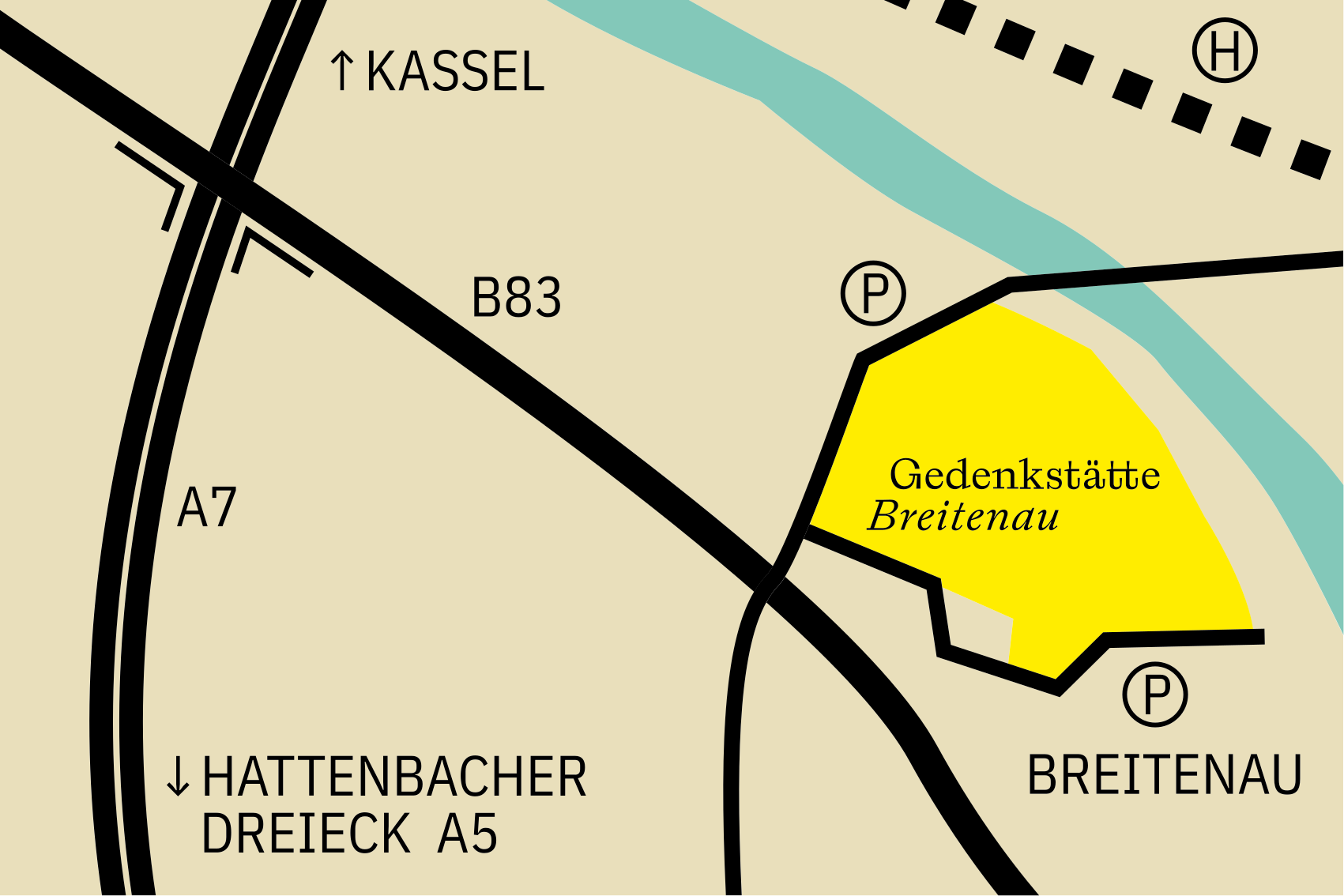
The Breitenau memorial is located in the town of Guxhagen, approximately 15 kilometers south of Kassel.
The memorial was founded by the University of Kassel with financial support from the Landeswohlfahrtsverbandes
Hessen in October 1984 on the property of the former Benedictine monastery of Breitenau. The memorial
rooms are located in an old monastery building; the remaining buildings house a psychiatric hospital.
Since 1986, the memorial has been run by an association of which various cities, groups, institutes and
individuals are members. The association receives a large portion of its funds as a grant from the
state of Hessen.
During the Nazi period, an early concentration camp (1933-1934) and later a so-called educational work camp
(Arbeitserziehungslager, 1940-1945) existed in the former monastery which had been dissolved in the l6th
century. For the most part, German political opponents were interned in the concentration camp in order
to be disciplined and intimidated. In the "education work camp", approximately 6.500 foreign forced
laborers who had either refused to work or who had violated Nazi regulations (by associating with Germans,
for example) were detained. through punishment they were to become more submissive in their next work
assignment. In addition, there were approximately 2.000 Germans imprisoned, among them approximately
250 Jews. Of the more than 8.000 prisoners, approximately 1.800 were deported to various concentration
camps.
In the memorial there is a permanent exhibition, a media projection room, a study room and a reference
library, an archive, and offices. The permanent exhibition is also, because of its artistic design, a
unique experiment in the conception of memorials of the Nazi period. There are two full-time employees
and two teachers who fulfil educational functions at the memorial. An unusually active relationship exists
between memorial and the university of Kassel in which Professor Krause-Vilmar, as the honorary director
of the memorial, oversees a close exchange of research. Tours are available at the memorial and there is a
wealth of material to enable and enhance further study. Through the available files, one can trace the
individual fates of people from all of the north and east Hessian regions. Through the files on hand, the
bureaucratic persecution machine in which, in addition to the Gestapo, many authorities, governmental
departments, firms and individuals participated, becomes evident.
Supplementary to these direct research resources of the Nazi period, the memorial offers special events
(readings, rectures, films, special exhibitions, etc.), in which issues of violence, exclusion, and
discrimination are addressed, thereby providing a link between the past and the present.
Gedenkstätte Breitenau
Brückenstraße 12
34302 Guxhagen
Phone: +49 (0)5665/3533
Fax: +49 (0)5665/1727
Internet: http://www.gedenkstaette-breitenau.de
E-Mail: gedenkstaette-breitenau@t-online.de
Information: Dr. Gunnar Richter / Horst Krause-Willenberg
The Breitenau Memorial Museum is located in Guxhagen and is accessible by train.
15 km south of Kassel on the A7 Kassel - Fulda
Monday - Friday 9 am to 1 pm and 2 pm to 4 pm (except holidays), Sunday 1 pm to 5 pm
|